
Why, why, why ... Delilah?!?
Heightened awareness is a start

In many respects, my 35-year consulting career began in Oshkosh, Wisconsin, at a small organization known locally by its acronym: RDAS, short for Regional Domestic Abuse Services. I had met the organization’s executive director, Eileen Connolly-Keesler*, who persuaded me to visit the RDAS shelter to heighten my awareness of their program.
This was winter 1989-’90 and, as I recall, I was going there with a small group of volunteers, perhaps from our church, I’m not sure. Unfortunately, I wasn’t feeling well the evening of our visit and went to bed instead. Paula went and saw the shelter. I vividly recall her reaction upon returning home. “You’ve gotta help these people!”
I did. Their fundraising campaign was wildly successful, due more to Eileen and talented volunteers than to their consultant. Eventually, my company assisted numerous domestic abuse agencies, invariably yielding gratifying results.
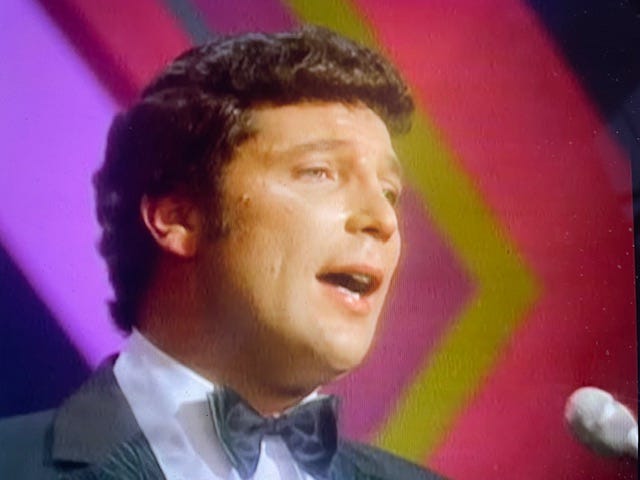
What brings this to mind was hearing a familiar song recently, a tune first popular in the late 1960s – “Delilah” by Tom Jones, released in February 1968. Music holds exceptional power to prompt time-traveling memories; I probably first heard Jones singing Delilah on a local radio station, spring 1968, when I was thirteen. I recall being struck by its pulsating rhythm and the singer’s powerful voice.
I knew nothing then about Tom Jones. Was he British? Maybe an African American? I honestly didn’t know… but I was captured by his vocal talents, described in an industry publication as a “full-throated, robust baritone.” In 2008, the New York Times referred to Jones as a “musical shapeshifter (who could) slide from soulful rasp to pop croon.” According to Jones, his style developed out of American soul music, influenced by the blues and by performers including Little Richard, Jerry Lee Lewis, and Elvis Presley, an early idol, eventually his friend.
Sir Thomas Jones Woodward, knighted by Queen Elizabeth twenty years ago, is a Welsh singer born in the 1940. A manager abbreviated his name to exploit the popularity of an Oscar-winning 1963 film, “Tom Jones,” based on the 1749 novel by Henry Fielding. A breakthrough moment for Jones / Delilah came on “The Ed Sullivan Show,” April 1968. [You MUST watch it: google “Tom Jones, Delilah, Ed Sullivan”. It’s been watched 43 million times, generating more than ten-thousand comments.]
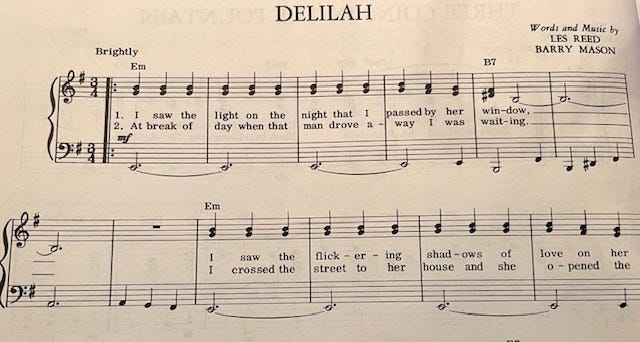
About the song. Composed in 3/4 time, somewhat unusual for pop melodies, the tune begins with ten identical, pounding notes. Heartbeats? Footsteps? There’s a throbbing relentlessness to the verse, in a minor key, which opens up to a sobbing, pleading chorus, featuring major chords. Jones wails his “whys,” unable to overcome his rage, admitting he “went out of his mind.” The result is a blend of a ballad and a Bizet opera, all at a brisk flamenco beat.
Two observations. In the video cited above, Ed Sullivan’s seventeen-person studio orchestra is conducted by Ray Bloch (1902 – 1982). His “joy jig” makes the YouTube video even more worthwhile. Second, while not in the Sullivan video, a studio musician named Reg Dwight provided backup vocals and piano accompaniment for Jones’s recording of Delilah. In 1972, this young man changed his name to Elton John.
While no detailed analysis of the song’s lyrics is necessary here (simplified, in a jealous fit, the narrator stabs and kills a woman he cared about), the name Delilah calls to mind the biblical story of woman who betrayed Samson, persuading him to explain that his strength was rooted in his flowing locks. Then, while he slept, Delilah cut Samson’s hair. Surely you remember this from Sunday school…
Finally, circling back to domestic abuse. In Wales, specifically Welsh rugby, Delilah became an unofficial anthem, sung often – with considerable gusto – at matches in certain stadiums, perhaps akin to “Sweet Caroline” at Fenway Park. At least some fans objected, however, about a song that “glorifies violence against women” or comes close to blaming the victim (after a great many plaintive “whys”).
In 2015, the Welsh Rugby Union pulled the song from its half-time entertainment and playlists for international matches. The controversy hasn’t subsided completely, but it seems heightened awareness has been brought to bear.
To which I say GOOD. It’s a start.
---------
*Today, Eileen is President / CEO of the Community Foundation of Collier County (FL), which includes Naples and Marco Island.
***************
My column, entitled “Showing Up,” is published weekly in the Nora Springs - Rockford Register. I’m also pleased to be part of the Iowa Writers’ Collaborative… click on the underscored link to see a list of the talented people who make up this innovative approach to journalism. I always welcome your feedback and, if you aren’t already a subscriber, I’d be thrilled if you became one. Thanks much! —KM